The Sri Mookambika Temple is located in Kollur village of Byndoor Taluk in the Udupi district of Karnataka. Positioned roughly 80 km away from Udupi town and 130 km away from Mangalore, this temple is built on the banks of the holy Agnitheertha River. The shrine stands tall against the breathtaking background of the Kodachadri hill peak, which is part of the Western Ghats mountain range.
Kollur Mookambika temple stand out completely among all other Shakti Peethas in India is its unique main deity. Inside the inner sanctum sanctorum (Garbhagriha), there is an ancient Udbhavalinga (a naturally formed stone Shiva Lingam).
A prominent, gleaming golden line (Swarna Rekha) splits this holy Lingam into two unequal halves. The left side, which is the larger part, represents the three sovereign female powers: Goddess Mahalakshmi (Wealth), Goddess Mahasaraswati (Knowledge), and Goddess Mahakali (Strength). The right side represents the holy male trinity: Lord Brahma, Lord Vishnu, and Lord Shiva.
Directly behind this unique Swayambhu Lingam stands the beautiful panchaloha (five-metal) idol of Goddess Mookambika, who is depicted with four arms, holding the divine disc and conch, granting blessings to all her children. The main temple tower (Gopuram) and the Kalasha are completely coated in shining gold, creating a heavenly sight for visitors.
The Ancient History and Mythological Legends
The roots of the Kollur Mookambika Temple are tied to a deep history detailed in regional puranas and ancient folk songs. The area was historically called Maharishi Kola Kshetra in honor of a great sage named Kola Maharshi.
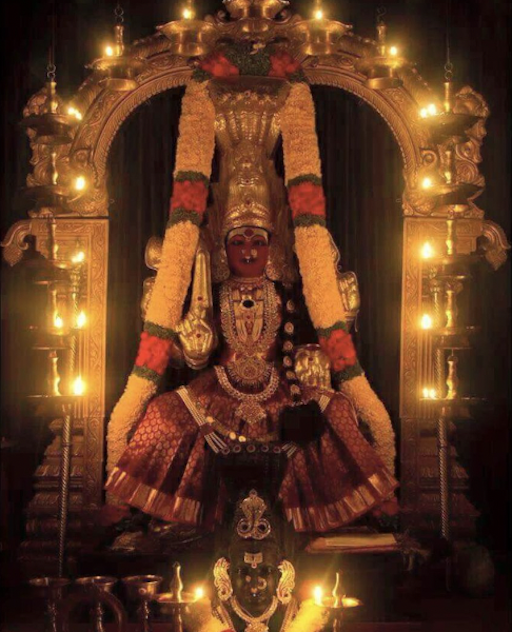
The Myth of Kamasura and the Name ‘Mookambika’
Thousands of years ago, a fierce demon named Kamasura performed intense penance to please Lord Shiva to win a boon of immortality. The Gods grew deeply terrified that if Kamasura received this boon, he would unleash ultimate destruction across the universe.
To stop him from speaking his evil wish, the Divine Mother, Vagdevi (the Goddess of Speech), made the demon completely dumb (mooka). When Lord Shiva appeared before him, the demon could not speak a single word. Furious at his helplessness, he came to be known as Kamasura or Mookasura.
Enraged by this cosmic trick, Mookasura began torturing the local sages, particularly Kola Maharshi, who was meditating peacefully in the valley. Responding to Kola Maharshi’s urgent prayers for protection, the Divine Mother descended to earth and killed the cruel demon on the auspicious night of Shukla Ashtami.
Following the victory, Kola Maharshi requested the Goddess to stay permanently at the valley to bless mankind. She happily agreed and combined all the cosmic energies of the universe into the holy spot to stay as a permanent protector.
The Arrival of Sri Adi Shankaracharya
In the 8th century AD, the legendary philosopher and saint, Sri Adi Shankaracharya, traveled to the Kodachadri hills to perform intense penance to invite Goddess Saraswati to move to Kerala. Pleased by his absolute devotion, the Goddess appeared before him but set a tough condition. She agreed to follow him on his walk down the hills, but warned him that he must never look back to check on her. If he turned back even once, she would freeze and stay permanently at that exact spot.
As they walked down the mountain path, Adi Shankaracharya could hear the beautiful jingling sound of the Goddess’s anklets behind him. However, as they reached the quiet plains of Kollur, the sound suddenly stopped. Unable to control his anxiety, Shankaracharya turned his head around. True to her word, the Goddess stopped right there.
Realizing his mistake, he begged for forgiveness. The compassionate Mother told him that she would remain at Kollur as Mookambika, combining both the Lakshmi and Saraswati forms.
Adi Shankaracharya then installed the sacred Sri Chakra with his own hands and consecrated the beautiful four-armed panchaloha idol of Goddess Mookambika directly behind the ancient stone Lingam. He also started the formal pooja systems that are followed rigorously to this day.
Deep Spiritual Significance of the Temple
Kollur Sri Mookambika Temple is considered a prime seat of knowledge and artistic perfection. Because the Goddess embodies the absolute energy of Saraswati (the deity of wisdom, arts, and speech), this temple holds massive significance for students, artists, musicians, and writers.
It is believed that visiting Kollur can clear speech defects, improve memory, and bring immense success in educational fields. It is a mandatory spiritual destination for anyone starting a new journey in classical music, dance, or traditional literature.
Daily Poojas, Sevas, and Temple Timings of Kollur Sri Mookambika Temple
The daily rituals at the temple are strictly managed based on the Agama Shastras. The temple remains open for nearly 16 hours a day to accommodate the continuous flow of pilgrims.
General Temple Timings
Morning Opening: 5:00 AM to 1:30 PM
Evening Opening: 3:00 PM to 9:00 PM
(On special festival days like Navratri, the temple remains open continuously without afternoon closures).
Important Daily Seva Schedule at Kollur Sri Mookambika Temple
Pilgrims looking to take part in special prayers should note this daily program:
| Time | Ritual / Pooja Name | Spiritual Importance |
| 5:00 AM | Dantadhawanotsavam | The morning brushing and waking ritual for the deity. |
| 6:30 AM | Usha Pooja | Morning prayers with fresh flower offerings. |
| 11:00 AM | Shikhara Pooja | Prayers offered directly to the golden temple tower. |
| 12:00 PM | Mahapooja | The main grand afternoon noon-prayer with naivedyam. |
| 6:30 PM | Pradosha Pooja | Evening rituals accompanied by classical instruments. |
| 7:30 PM | Mangalarati & Bali Utsav | The daily chariot procession of the deity around the inner walls. |
| 8:30 PM | Kashaya Mangalarati | A unique night offering where a healthy herbal hot drink is distributed to devotees. |
The Unique “Kashaya” Prasadam
A highly unique practice started by Sri Adi Shankaracharya is the distribution of Kallur Kashaya during the final night pooja. It is a hot herbal drink prepared using fresh ginger, pepper, cardamom, jaggery, and secret medicinal herbs found in the Kodachadri forests. This hot drink is given out free to all devotees at night because it is believed to have powerful healing properties that can cure various physical ailments.
Vidyarambham: The Initiation of Knowledge
The most popular seva performed at Kollur is Vidyarambham (the formal initiation of a child into the world of letters and education). Every single day, hundreds of parents bring their toddlers (usually aged between 2 to 4 years) to the temple’s Saraswati Mandapam. Under the guidance of temple priests, children write their very first alphabet letters in a tray of raw rice grains or have the sacred syllable “OM” written gently on their tongues with a golden ring.
Major Festivals Celebrated with Grandeur
- Sharad Navratri (September/October): This is the biggest and most spectacular festival celebrated at Kollur, stretching over 9 days. The entire temple is decorated with tons of colorful flowers and thousands of traditional oil lamps.
- Vidyarambham on Vijayadashami: On the final tenth day of Navratri, thousands of children gather to start their education, making it a very emotional and grand event.
- Annual Rathotsava (March): The grand car festival takes place in the breezy month of March. The festival deity is placed on a massive decorated wooden chariot and pulled across the streets of Kollur by thousands of singing devotees.
Detailed Travel Distance and Accessibility Matrix
Kollur is located in a valley within the Western Ghats, making it easily reachable by a network of well-maintained ghat roads and national highways. Here is an exact breakdown of how to reach Kollur from major Indian cities, complete with estimated distances and best travel options.
1. Distance from Bangalore to Kollur Sri Mookambika Temple
- Distance: 430 km
- Best Route: Bangalore → Tumkur → Shimoga → Hosanagara → Nagara Ghat → Kollur.
- Alternate Route: Bangalore → Hassan → Sakaleshpura → Mangalore → Udupi → Kollur.
- By Bus: Multiple overnight luxury sleepers (KSRTC, Durgamba, SRS, Sugama) operate daily directly from Majestic and satellite bus stands in Bangalore. It takes around 8 to 9 hours.
- By Train: You can take the overnight train from Bangalore to Byndoor Mookambika Road Railway Station (BYNR), which is the closest railway station to Kollur, located just 28 km away.
2. Distance from Mangalore to Kollur Sri Mookambika Temple
- Distance: 130 km
- Best Route: Mangalore → Udupi → Kundapura → Hemmadi → Kollur.
- By Road: This is a short, scenic 3 hours drive. Regular local express buses travel every 15 minutes from Mangalore KSRTC or Private Bus Stand to Kundapura, from where you can take frequent direct connecting buses to Kollur.
Private express bus service from Mangalore to Kollur and Udupi to Kollur
3. Distance from Cochin (Ernakulam) to Kollur Sri Mookambika Temple
- Distance: 480 km
- Best Route: Cochin → Kozhikode → Kannur → Kasaragod → Mangalore → Udupi → Kundapura → Kollur.
- By Train: This is the most preferred option for travelers from Kerala. Multiple trains running from Ernakulam toward Goa or Mumbai stop directly at the Byndoor (BYNR) or Kundapura (KUDA) stations.
4. Distance from Thiruvananthapuram (Trivandrum) to Kollur Sri Mookambika Temple
- Distance: 690 km
- Travel Access: The best option is to take direct trains like the Netravati Express or Rajdhani Express up to Byndoor station. Alternatively, you can book a direct flight from Trivandrum to Mangaluru International Airport (IXE).
5. Distance from Chennai to Kollur Sri Mookambika Temple
- Distance: 770 km
- Best Route: Chennai → Bangalore → Shimoga → Kollur.
- Travel Access: You can catch a direct evening flight from Chennai to Mangalore, or take an overnight train from Chennai Central to Mangalore, followed by a local cab ride to Kollur or Frequent Bus travel from Mangalore to Kollur
6. Distance from Mumbai to Kollur Sri Mookambika Temple
- Distance: 930 km
- Best Route: Mumbai → Pune → Kolhapur → Belgaum → Hubli → Yellapur → Kumta → Byndoor → Kollur.
- Travel Access: Traveling via the Konkan Railway is an unforgettable experience. Trains like the Matsyagandha Express or Mangala Lakshadweep Express leave Mumbai daily and drop you directly at Byndoor station in approximately 14 to 16 hours.
By Flight: You can catch a direct flight from Mumbai to Mangalore followed by a local cab ride to Kollur or Frequent Bus travel from Mangalore to Kollur
Incredible Tourist Places to Visit Near Kollur
If you are visiting Kollur, you can easily turn your pilgrimage into a great vacation by exploring these spectacular nearby natural wonders:
- Kodachadri Mountain Peak (21 km away): A paradise for adventure lovers and trekkers. You can hire local 4×4 off-road Jeeps from the Kollur temple base to go up the rugged mountain pathways. At the very top sits the historic Sarvajna Peetha, a small stone structure where Sri Adi Shankaracharya sat in deep meditation.
- Arasinagundi Falls (6 km away): A breathtaking waterfall hidden deep inside the Mookambika Wildlife Sanctuary. The water drops down fiercely from a height of about 50 feet, creating a gorgeous mist. Note: You need to obtain a quick trekking permission from the local forest department office before heading down this jungle trail.
- Maravanthe Beach (35 km away): One of India’s most unique coastal highways where the roaring Arabian Sea waves crash on one side of the road, while the calm, freshwater Sauparnika River flows gracefully right on the other side.
- Murudeshwar Temple (60 km away): Located just an hour’s drive north from Kollur, this famous coastal town features the world’s second-tallest Lord Shiva statue standing tall on a hill right next to the sea, along with a massive 20 story temple Gopuram.
Essential Facilities and Food Options
- Free Feeding (Anna Prasadam): To ensure no traveler goes hungry in the dense forest valley, the temple provides free, high-quality, delicious lunch and dinner daily to all visitors at its massive Mookambika Bhojana Shale complex. The meals are completely vegetarian and prepared cleanly.
- Accommodation options at Kollur Sri Mookambika Temple: The temple administration runs several budget-friendly guest houses (like Souparnika, Jagadambika, and Saraswathi blocks) that can be booked online or directly at the counter. Additionally, there are dozens of premium private luxury hotels and traditional homestays spread across the banks of the river in Kollur village.
FAQ’s of Kollur Sri Mookambika Temple
Kollur Mookambika Temple is located in Kollur village, in Udupi district of coastal Karnataka, India. The temple is situated near the Western Ghats and is surrounded by green hills, forests and beautiful natural scenery. The Sauparnika River flows near the temple area.
Kollur is an important pilgrimage destination for devotees of Goddess Mookambika. Many people visit the temple to seek blessings for education, career, family happiness, health and success in life. The temple is also a popular destination for families planning a religious trip in coastal Karnataka.
Goddess Mookambika is a form of Adi Parashakti, the supreme divine feminine energy in Hindu tradition. She is worshipped as a powerful goddess who represents knowledge, courage, prosperity and protection.
At Kollur, Goddess Mookambika is worshipped in a unique form that combines the divine energies of Goddess Mahakali, Mahalakshmi and Mahasaraswati. Devotees believe that worshipping the goddess brings peace, strength, wisdom and spiritual progress.
Kollur Mookambika Temple is famous for its spiritual importance, ancient traditions and association with Goddess Mookambika. It is particularly popular among devotees seeking blessings for education, children’s learning, career growth and family well-being.
The temple is also known for its connection with Adi Shankaracharya and the tradition of Saraswati worship. Many parents bring their children to the temple for Vidyarambham, a ceremony that marks the beginning of formal learning. Its location near the Western Ghats makes Kollur an attractive destination for both pilgrims and nature lovers.
Kollur Mookambika Temple has a long history rooted in Hindu religious traditions and local legends. According to popular tradition, Goddess Mookambika appeared to destroy the demon Mookasura, who was troubling sages and devotees. The goddess is therefore worshipped as a protector who removes evil and restores peace.
The temple is also associated with Adi Shankaracharya, the great Hindu philosopher. Traditional accounts connect him with the worship and establishment of the goddess’s sacred presence at Kollur. Over time, the temple developed into one of the important Shakti pilgrimage centres in South India.
According to Hindu tradition, Mookasura was a demon who troubled sages and performed actions that disturbed religious practices. The gods prayed to the Divine Mother for help. Goddess Adi Parashakti appeared and defeated Mookasura, protecting the sages and restoring peace.
The name Mookambika is traditionally associated with the goddess who defeated Mookasura. Devotees worship her as a symbol of victory over evil, ignorance and difficulties. This story is an important part of the temple’s religious identity.
Adi Shankaracharya is an important figure in the religious history of Kollur Mookambika Temple. According to temple tradition, he meditated and worshipped the goddess and consecrated her image at the temple.
The association with Adi Shankaracharya has made Kollur an important destination for devotees, spiritual seekers and people interested in Indian philosophy. His teachings continue to influence Hindu religious traditions across India.
The main object of worship at Kollur Mookambika Temple is a sacred, self-manifested Linga associated with the union of Lord Shiva and Goddess Shakti. It is traditionally described as having a golden line, known as the Swarna Rekha.
This form represents the belief that Shiva and Shakti are closely connected and that divine power includes both creative energy and consciousness. Devotees worship the Linga as a sacred symbol of the goddess’s divine presence.
Kollur Mookambika Temple is an important Shakti worship centre in South India. It is also recognised in Karnataka’s religious tradition as one of the seven sacred Mukti Sthalas, or places associated with spiritual liberation. The temple is especially important for devotees of the Divine Mother and those seeking blessings for knowledge, courage and prosperity
According to the temple’s published schedule, the general worship and darshan periods are:
Session Published timing
Morning 5:00 AM–1:30 PM
Afternoon 3:00 PM–5:00 PM
Evening 5:00 PM–9:00 PM
The temple has a break between 1:30 PM and 3:00 PM. Specific poojas and rituals may temporarily affect darshan, and afternoon arrangements can differ from regular worship periods. Timings may also change on festival days.
Early morning is a good time to visit Kollur Mookambika Temple if you prefer a peaceful darshan experience. Reaching the temple before the main morning crowd can also help you plan the rest of your pilgrimage.
The temple can be visited throughout the year. October to March is generally comfortable for sightseeing around Kollur, while the monsoon months bring heavy rain and lush greenery to the Western Ghats. During Navaratri, Vijayadashami and other important festivals, the number of devotees can increase significantly.
General darshan is normally available without an entry fee. However, special darshan arrangements, poojas, sevas and other religious services may have separate charges.
Visitors should check the temple’s official information for current fees, booking procedures and payment arrangements. Use official temple channels for advance bookings and avoid paying unauthorised agents.
You can keep around one to two hours for a regular temple visit, including darshan and time for prayer. During weekends, public holidays, Navaratri and Vijayadashami, waiting times may be longer.
If you are travelling with children or senior citizens, allow additional time. Pilgrims who wish to attend a particular pooja should plan their arrival according to the temple schedule.
Vidyarambham is a traditional Hindu ceremony that marks the beginning of a child’s formal learning. At Kollur Mookambika Temple, many parents bring their young children to seek Goddess Mookambika’s blessings before beginning their educational journey.
During the ceremony, children are traditionally guided to write their first letters or words. The ritual is also known as Aksharabhyasam in many parts of India. Parents believe that beginning a child’s education with the blessings of Goddess Mookambika is auspicious because she is associated with knowledge and wisdom.
Vidyarambham is especially popular on Vijayadashami, the final day of Navaratri. Many families visit Kollur on this occasion to introduce their children to learning and seek the goddess’s blessings.
The temple may make special arrangements during the festival, and crowd levels can be high. Parents should check the official temple announcements for the current year’s ceremony timings, registration process and instructions.
Parents bring children to Kollur Mookambika Temple to seek blessings for education, concentration, wisdom and a successful future. The goddess is widely respected as a divine source of knowledge and learning.
The temple is particularly popular with families from Karnataka and Kerala. Many parents plan their visit around Vidyarambham, while others perform prayers or special sevas for their children’s educational progress.
Chandika Homa is a Hindu fire ritual performed in honour of the Divine Mother. It involves the chanting of sacred verses and making ritual offerings into the holy fire.
At Kollur Mookambika Temple, this ritual is associated with the worship of Goddess Mookambika. Devotees arrange the homa according to the temple’s procedures to offer prayers and seek divine blessings. Contact the temple for details about booking, fees and available dates.
Navaratri is one of the most important festivals dedicated to Goddess Durga and the Divine Mother. At Kollur Mookambika Temple, this period is marked by special worship, religious ceremonies and a large number of visiting devotees.
Many families visit the temple during Navaratri to pray for knowledge, courage, prosperity and family well-being. Vijayadashami, which marks the conclusion of Navaratri, is especially significant for Vidyarambham ceremonies.
Goddess Saraswati represents knowledge, wisdom, education, music and the arts. Since Goddess Mookambika is worshipped as a form that includes Mahasaraswati, the temple has a special place in the hearts of students, teachers, parents, artists and musicians.
Many devotees visit Kollur before examinations, when starting a new course or when beginning to learn music and other arts. They pray for concentration, confidence, creativity and success in their studies.
Yes. Students from different parts of India visit Kollur Mookambika Temple to pray for wisdom, concentration and success in their examinations. Parents also bring school-going children and college students to seek the goddess’s blessings.
Students can visit throughout the year and offer prayers according to their family traditions. The temple’s association with Goddess Saraswati makes it a popular spiritual destination for those beginning or continuing their education.
Kundapura and Byndoor railway stations are among the useful railway options for visitors travelling to Kollur. The best station depends on your train’s route and schedule.
After reaching the railway station, you can use buses, taxis or other available road transport to reach the temple. Check the distance and onward transport availability before selecting your train.
Yes. Buses operate on routes connecting Kollur with nearby towns and other destinations, although the frequency and direct connections depend on the route and time of day.
Travellers can check current services from Udupi, Kundapura, Mangaluru and other major towns. During major festivals, transport demand can increase, so advance planning is recommended.
Yes. Kollur has accommodation options for pilgrims, including guest houses, lodges, hotels and other stays. Some facilities may be associated with temple or religious institutions, while others are privately operated.
Room availability can become limited during Navaratri, Vijayadashami, weekends and other busy periods. It is advisable to book accommodation in advance and confirm the check-in time, facilities and cancellation policy.
Yes. Visitors can find vegetarian restaurants and eateries serving South Indian meals, breakfast items and other simple dishes near the temple area. Food availability may vary according to the time of day.
Some pilgrim facilities may also provide meals according to their own arrangements. If you require food at a particular time, especially when travelling with children or senior citizens, check the available options in advance.
Yes. Senior citizens can visit the temple for darshan and prayer. However, walking distances, queues, weather and crowd levels should be considered when planning the visit.
An early morning visit on a less crowded day may be more comfortable. Families should check the availability of assistance, seating and other facilities with the temple administration if required.
Visitors should wear clean, modest and respectful clothing suitable for a place of worship. Traditional Indian attire is commonly worn by devotees.
Specific rules may apply to certain religious services or rituals. Check the temple’s current instructions before attending special poojas, and follow all directions given by temple staff.
Official Temple Contact Details for Bookings
For booking special sevas, checking room availability, or organizing group poojas, travelers can directly contact the administrative office of the temple:
- Address: Executive Officer,
Sri Mookambika Temple, Kollur,
Byndoor Taluk, Udupi District,
Karnataka – 576220, India. - Official Office Phone Numbers: +91 8252 2758221 / +91 8252 258221
- Official Website: www.srikollurmookambikatemple.org
Plan your trip to the peaceful valley of Kollur to receive the powerful, life-changing blessings of Goddess Sri Mookambika Devi !