Mandasmita lalitavaktre, dhautaambarabhooshitagaatre |
Karunaapoornanetre pavanee krata bappanadu kshete |
Simhavaahanasmite vrandaaravranda vandite |
Abhaya varadahaste sujanaparirakshanaasakte |
Sri parameshwari, namostute |
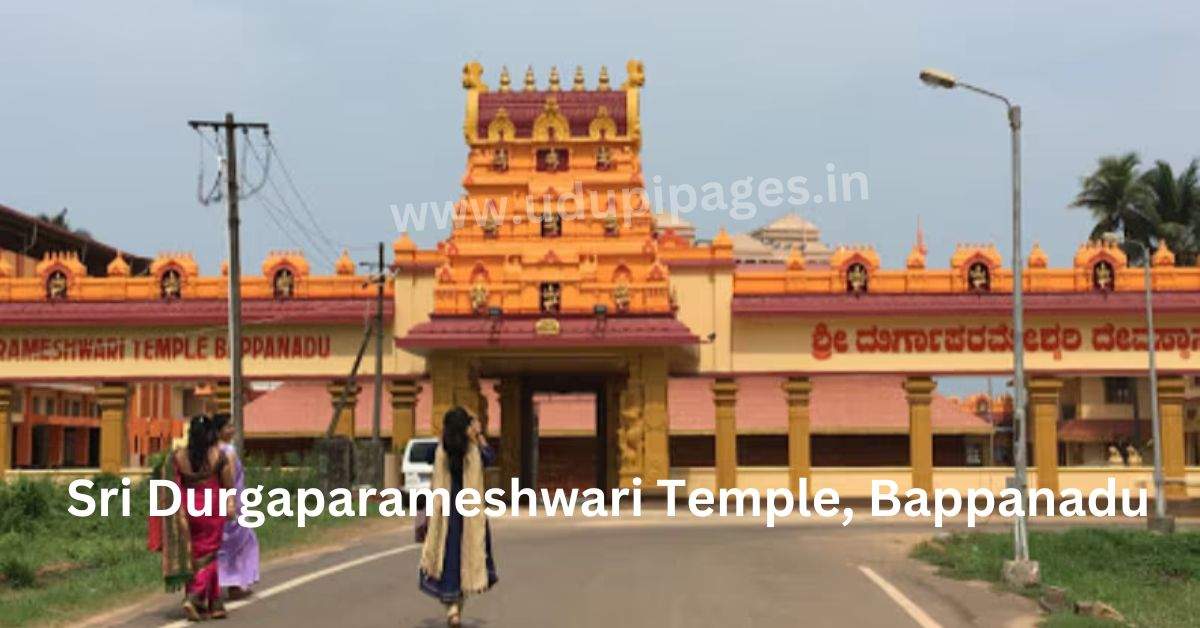
The Sri Durgaparameshwari Temple in Bappanadu is a very famous and old temple, located in Mulki, near Udupi-Mangalore Highway, in Karnataka. This temple is quite special because of its unique history of religious harmony and its divine atmosphere.
About Sri Durgaparameshwari Temple, Bappanadu
The Bappanadu Shri Durgaparameshwari Temple is an ancient & holy pilgrimage center beautifully situated on the sacred banks of the river Shambhavi in Bappanadu village of Mangalore. Located just 29 km north of the Mangalore city and roughly 30 km south of the temple town of Udupi, it is highly accessible along National Highway 66 (formerly NH-17) which is Panvel to Kochi highway.
The main deity worshipped here is Goddess Sri Durgaparameshwari, who is revered in the symbolic form of a holy Linga (Swayambhu symbolic statue). This temple counts as one of the prominent Sapta Shakthi Kendras (Seven Centers of Shakti Power) in the Tulunadu region, carrying an architectural legacy that local experts trace back to the 14th century.
A important tradition that leaves an impression on visitors is the grand Bappanadu Dolu a massive, historic musical instrument drum kept at the side of the temple. The thunderous beats of this drum are center of attraction at the annual temple festivities, embedding themselves so deeply into local folklore that the drum remains an iconic symbol of Tulunadu’s heritage.
The Fascinating History and Divine Legends
The history of the Bappanadu temple blend regional mythology, historical legends, and real-world examples of interfaith unity.
The Myth of Demon Darigasura and Sapta Durgas According to temple scriptures, there once lived a fierce demon king named Darigasura who ruled over a kingdom called Shonitapura. He harbored deep enmity toward the Devatas and Lord Vishnu. Driven by a desire for supreme power, he performed intense penance to please Lord Brahma and succeeded in gaining a divine boon. Armed with this invincible power, he defeated the Gods and managed to seize the protective weapons of Lord Vishnu.
As Lord Vishnu mourned the loss of his divine weapons, Goddess Durgaparameshwari manifested before him in the forms of seven divine angel-women, known as the Sapta Durgas, promising to destroy the demon. Through divine trickery, Goddess Bhagavathi (one of the sisters) disguised herself and visited Darigasura’s palace while he was away, convincing his wife to hand over Lord Vishnu’s weapons.
Discovering he had been outsmarted, Darigasura grew furious and declared war against the Sapta Durgas. A fierce battle raged for seven straight days. Ultimately defeated, Darigasura fled the battlefield and hid in the underworld. Goddess Bhagavathi took the form of Bhadrakali to track him down, completing her divine mission.
The Wooden Boat Journey to Tulunadu
Following their victory, the sister Goddesses and their guardian deity, Guliga, desired to travel from Vaikunta (the celestial heaven) down to Bhooloka (the earthly realm) to settle down and bless humanity. Lord Vishnu permitted them to cut a sacred sandalwood tree from heaven to construct a boat for their journey.
The sandalwood boat sailed down to earth and traveled along the southern coastline, crossing places like Kasaragod, Kumble, Manjeshwara, and Ullala before finally arriving at the shores of Sasihithlu, right near Mulki town. Moved by the simple devotion of a local lower-caste devotee who offered them tender coconut water, the Goddess chose to halt her journey. Goddess Durgaparameshwari emerged symbolically at the beautiful confluence point where the Shambhavi and Nandini rivers meet.
The Legend of Bappa Beary and the Jain King
Centuries later, the temple grounds lay ruined due to heavy seasonal flooding of the Mulki river, leaving only the sacred Lingas untouched beneath the waters. During this time, a devout Muslim merchant named Bappa Beary from Kerala was sailing up the Shambhavi River to trade his goods. Suddenly, his cargo boat ground to a complete halt in the middle of the river.
Looking over the edge, Bappa was startled to see the river water turning a deep, blood-red color. Filled with fear, he offered his prayers and eventually fell into a deep sleep on the stranded vessel. In his sleep, a luminous form of Goddess Durgaparameshwari appeared in his dream. She proclaimed that there is only one supreme God for the entire world, though worshipped by different names, and commanded him to build a shrine for her at that location.
Bappa Beary took this divine command to heart. He approached the local Jain ruler of Mulki, Dugganna Samanta (Mulki Sawantha), and related the miraculous incident. The benevolent Jain king, using material contributions from Bappa Beary and other donors, constructed a grand temple. They appointed a pious priest named Baila Udupa to oversee the Vedic rituals. To honor the merchant’s instrumental role, the entire settlement came to be known as Bappanadu (“Bappa’s village”).
Ultimate Significance: A Beacon of Harmony
The Bappanadu Kshetra stands as a historical marvel of communal unity in India. For over seven centuries, the temple has maintained an unbroken tradition of interfaith collaboration:
The Bappa Beary Honor: To this day, when the annual temple festival (Brahma Rathotsava) commences, the very first batch of sacred Prasada and blessings is officially taken in a grand procession to the home of Bappa Beary’s descendants.
Active Interfaith Participation: Local Muslims and Christians actively take part in the temple’s seasonal celebrations. Many local Christian families cultivate special jasmine flowers (Mulki Mallige) and ensure they are supplied preferentially to the temple to decorate the Goddess during festive nights. Devotees from all communities regularly line up to offer individual sevas like Durga Namaskara and participate in the community feeding programs.
Essential Temple Timings and Daily Poojas of Sri Durgaparameshwari Temple, Bappanadu
The temple administrative authorities maintain a disciplined schedule for public darshan and daily Vedic rituals:
Daily Timings: 6:00 AM to 9:30 PM
(Open throughout the day, though timings may adjust during the peak annual festival weeks).
Standard Daily RitualsMorning Pooja (Usha Pooja): Performed at dawn, featuring the decoration of the Linga with fresh tulsi leaves and flowers.
Afternoon Mahapooja: The main noon ritual, accompanied by bells, the blowing of conch shells, and the serving of hot community lunch (Annadanam) to visitors.
Night Rangapooja: A visually stunning evening ritual where rows of oil lamps are lit across the inner temple pathways, reflecting off the metal icons.
Standard Daily Rituals
- Morning Pooja (Usha Pooja): Performed at dawn, featuring the decoration of the Linga with fresh tulsi leaves and flowers.
- Afternoon Mahapooja: The main noon ritual, accompanied by bells, the blowing of conch shells, and the serving of hot community lunch (Annadanam) to visitors.
- Night Rangapooja: A visually stunning evening ritual where rows of oil lamps are lit across the inner temple pathways, reflecting off the metal icons.
Rituals & Festival Calendar
The Bappanadu temple calendar features vibrant, centuries-old festival arrangements that attract large crowds:
Sharad Navratri: A grand 9-day celebration in autumn, where the deity is adorned in distinct avatars every day, drawing large crowds.
The 21-Day Annual Jatra (March/April): The landmark event of the temple is its annual fair, culminating in the grand Brahma Rathotsava (Chariot Festival). The main festivities follow an exact daily ritual sequence:
Day 1: Dwajarohana – The formal hoisting of the holy flag.
Day 2: Bali Utsava & Ayana Deepotsava – Traditional torchlight processions.
Day 3 & 4: Pete Sawari & Koppala Sawari – The deity’s ceremonial tour through the town quarters.
Day 5 & 6: Bakimaru Deepotsava & Kere Deepotsava – Scenic lake and field lamp-lighting rituals.
Day 7: Morning Car Festival – Thousands pull the massive wooden Brahma Ratha across the streets.
Agni Keli (The Fire Play): A jaw-dropping religious tradition held during the annual festival. Devotees divide into two groups and throw flaming palm-frond torches at each other in a controlled, dramatic ritual display of courage and devotion to please the fiery Agni Durga.
Distances and Travel Access from different cities
Bappanadu is connected via National Highway 66, making it easily reachable from primary transport hubs across India. Here is the precise distance and travel routing data for travelers:
| Origin City | Distance to Temple | Recommended Travel Mode & Routing Details |
| Mangalore | 29 km | Fastest Access: A short 45-minute drive via NH-66 north. Local service buses run every 10 minutes from Mangalore’s State Bank bus terminal directly toward Mulki/Udupi. |
| Udupi | 30 km | Direct Access: Drive south for 40 minutes along NH-66. Any express or local bus running from Udupi to Mangalore will drop you right at the Bappanadu temple junction. |
| Bangalore | 375 km | By Road: Drive via NH-48 through Hassan, Sakleshpur ghats, and Mangalore. By Rail: Board the overnight train from Majestic to Mangalore or the Karwar Express, alighting at Surathkal or Mulki station. |
| Cochin | 470 km | By Rail: Take any Konkan-bound express train from Ernakulam to Mangalore Central, then catch a local cab or bus north. By Road: Follow NH-66 along the Kerala-Karnataka coastline. |
| Trivandrum | 680 km | By Air: Fly from Thiruvananthapuram to Mangaluru International Airport (IXE), followed by a 40-minute prepaid taxi ride to the temple. |
| Chennai | 720 km | By Rail: Take the Chennai-Mangalore Superfast Express to Mangalore Central station, followed by local highway transport. |
| Mumbai | 960 km | By Rail: The Konkan Railway is the most efficient option. Board the Matsyagandha Express from LTT directly to the Mulki Railway Station, located just 4 km from the temple gates. |
Accommodation and Stay Options Near the Temple
While Bappanadu can easily be visited as a day trip from Mangalore or Udupi, several stay options are available for overnight visitors:
Temple Guest Houses: The temple trust manages basic, clean rooms for pilgrims at nominal charges, available on a first-come, first-served basis.
Hotels in Mulki Town: Mulki town features budget lodges, air-conditioned rooms, and traditional homestays catering to travelers visiting the local temples or surfing schools.
Surathkal & Mangalore Stays: For luxury accommodation, visitors can stay at beach resorts in Surathkal (12 km away) or business hotels in Mangalore city (29 km away).
Popular Places to Visit Near Bappanadu
You can easily pair your visit to the temple with these nearby cultural and natural landmarks:
Sasihithlu Beach (6 km away): The holy historical shore where the Goddess’s boat first arrived. Today, it is a serene, crowd-free white sand beach globally recognized as a premier surfing destination in India.
Kateel Sri Durgaparameshwari Temple (15 km away): Another iconic Shakti shrine located nearby. The temple is situated on an island in the middle of the flowing Nandini River.
Bappanadu Keremane (Temple Lake): A peaceful water body located close to the main shrine, used for the annual Kere Deepotsava boat rituals.
Sri Venkatramana Temple, Mulki (1.5 km away): An ancient, historically rich temple belonging to the Gowd Saraswat Brahmin (GSB) community, located just a short auto-rickshaw ride away.
Official Temple Contact Information
For information regarding special festival dates, booking Durga Namaskara Seva, or arranging group feeding programs, you can reach out directly to the temple administration:
Address:
Administrative Office,
Sri Durgaparameshwari Temple Bappanadu,
Mulki, Mangalore Taluk, Dakshina Kannada District,
Karnataka – 574154, India.
Location Convenience: The main temple arch faces the national highway directly, making it easy for visitors to spot.
Experience the unique spiritual energy, historic interfaith legacy, and vibrant coastal traditions at the Bappanadu Sri Durgaparameshwari Temple on your next journey through coastal Karnataka!