

What Is Udupi Paryaya?
About 700 years ago, Jagadguru Sri Madwacharya, the scholarly saint and the exponent of Dwaita Philosophy installed an enchantingly beautiful idol of Lord Sri Krishna at Udupi. Legend has it that this was the very same idol which Rukmini Devi had lovingly worshipped during the Dwapara Yuga. Ever since the idol was installed, Udupi has been steadily gaining in importance as a hoary centre of pilgrimage. It was left to Sri Vadiraja Swamy to establish eight Maths and to enjoin that the Swamiji of each of these Maths should worship Lord Sri Krishna for two years at a stretch by turns. The biennial event of this transfer of charge came to be known as Paryaya. It is intriguing to note how this formal transfer of charge evolved down the centuries and culminated in assuming the dimensions of a festival of pomp and pengeantry comparable with the fabulous Dasara of Mysore.
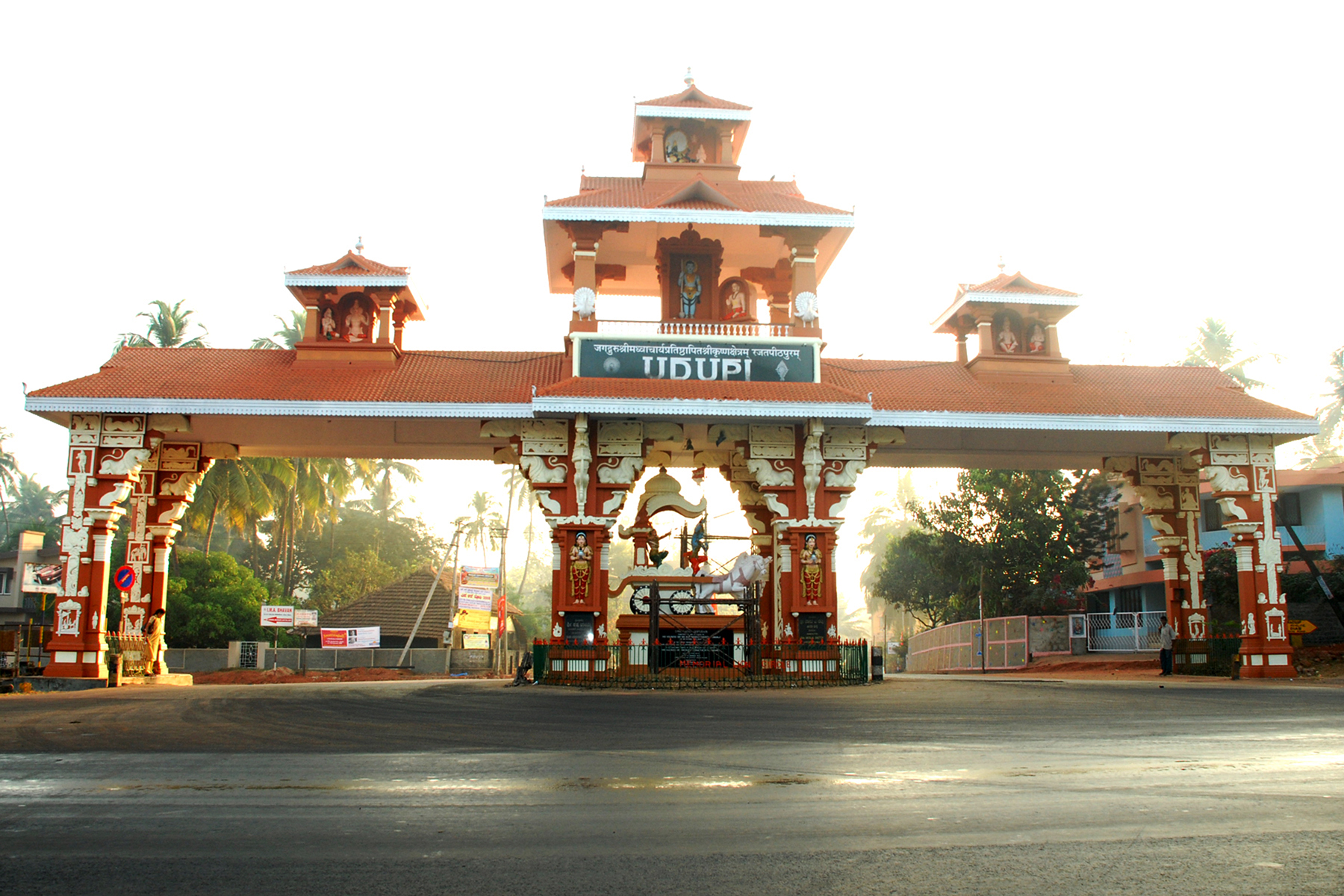
History of Udupi Paryaya?
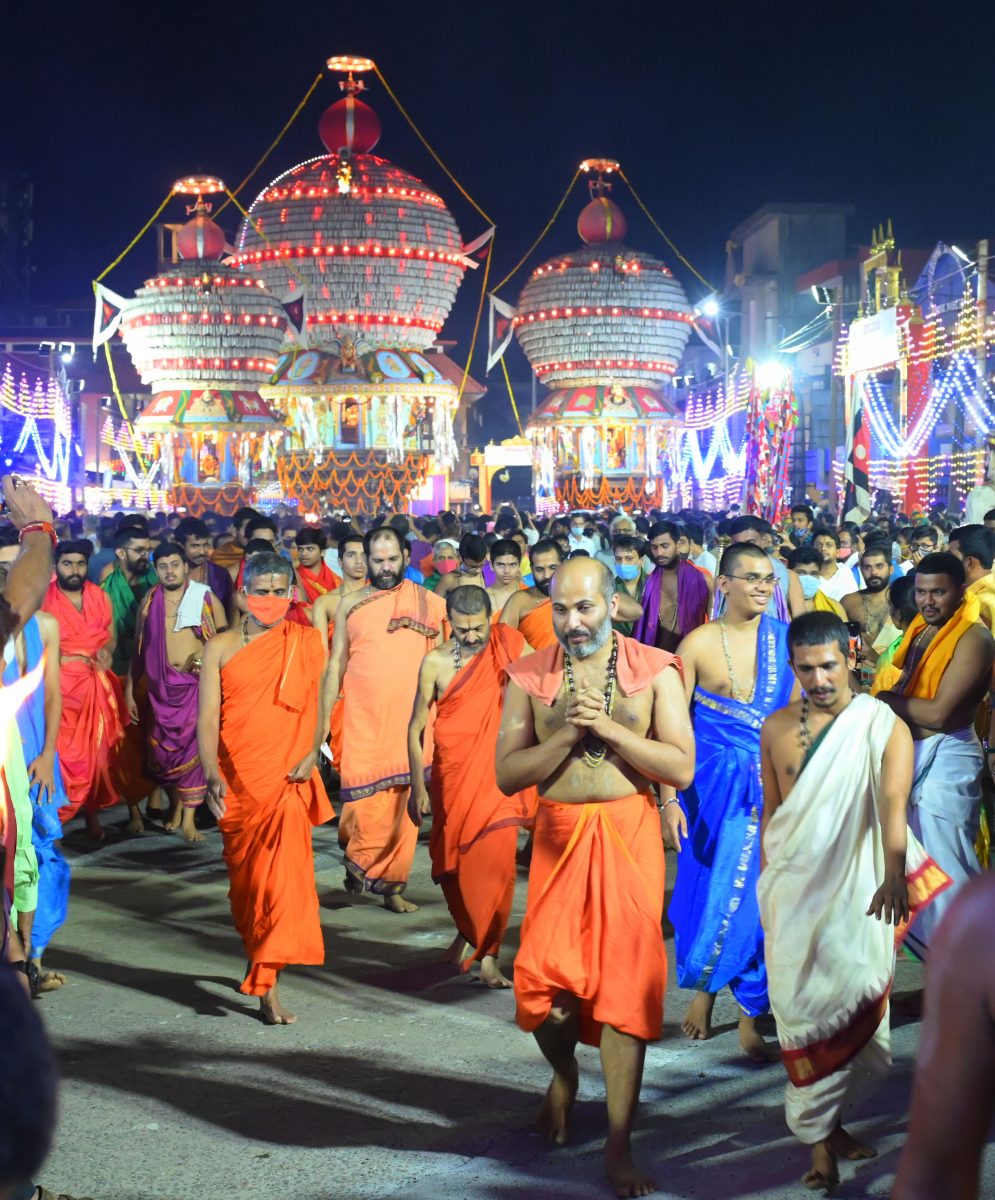
Dasara on the one hand and the Paryaya on the other is too striking to be coincidental. The Paryaya procession, ascending the throne, the Darbar and the chariot festival are a few among the highlights of Paryaya. On the eve of the Paryaya, the Swamiji proceeds to the holy Danda Teertha. In the early hours next morning he finishes the ablutions as well as the morning rituals and then returns to Jodukatte. By this time the Swamijis of the different Maths will have arrived there in palanquins. Thousands of devotees will also be waiting there to receive the incoming Swamiji. A breathtakingly spectacular procession with caparisoned elephants and giant guises on the lead, with colourful banners and buntings fluttering in the morning breeze, with numerous tableaux adding pomp and pageant at regular intervals and with bands and nadaswaram playing cheerful notes,Udupi paryaya – Darbar Hallwinds its way along street. A red carpet reception awaits them at this point. The Swamijis get down from their palanquins and proceed on foot. The prospective Paryaya Swamiji gets a ‘Darshana’ (glimpse) of Lord Krishna through the ‘Kanakana Kindi’ (Kanaka’s window) and after offering prayers at Anantheswhara and Chandreshwara temples, arrives at the main entrance to the Sri Krishna Temple. The outgoing Swamiji receives him there and they enter the temple and pray before the image of Lord Krishna. Then the outgoing Swamiji hands over the hallowe “Akshaya Patra” the ladle and the keys of the sanctum sanctorum to the incoming Swamiji in the presence of the image of Sri Madhwacharya and at his request the incoming Swamiji occupies the throne. This is the same throne which Sri Madhwacharya used to occupy during those days.
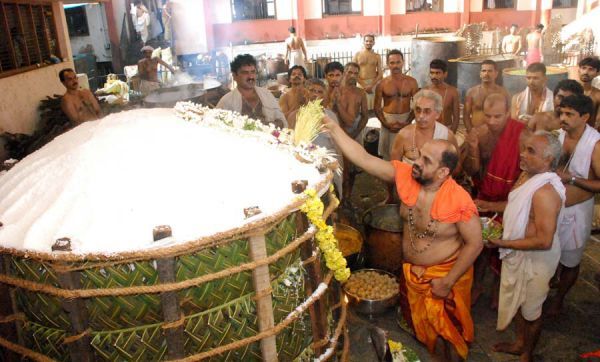
The next important item in the programme is the mammoth public meeting at the Rajangana where dignitaries offer felicitations to the Paryaya Swamiji. Religious discourses are held and eminent scholars who have made outstanding contributions in their respective fields are honoured at this meeting in a befitting manner. At nightfall ‘theppotsava’ is celebrated in the Madhwa Sarovar where the image of Lord Krishna is taken round in a specially designed and colourfully illuminated boat chariot. One of the most significant events associated with the Paryaya is the Brahma Rathotsava (chariot festival) which takes place at night. The image of Lord Krishna is placed in the Brahma Ratha (huge chariot). After a series of rituals the chariot is drawn along the car street by thousands of devotees. The crescendo of ecstatic shouts of devotion reverberates in the still night. Hour long fire – works weave exotic patterns against the night sky. The streets will be swarming with tens of thousands of devotees, enthralled and rejoicing. The Paryaya Math, with its dazzlingly colourful illumination, becomes the cynosure of all eyes. As soon as the chariot completes its round, the image is taken to Vasantha Mahal for Valaga Mantapa Puja. Lord Krishna is placed in a golden cradle and swung to and fro to the accompaniment of vedic hymns and devotional songs. After this, the image is carried back to the sanctum sanctorum. This marks the close of the festival and the curtains will be down.
Who is current paryaya Swmiji (2024-2026) in Udupi Sri Krishna Temple?
The current Paryaya Swamiji is Sri Sugunendra Theertha Swamiji of Puthige Matha. On 18 January 2024, he ascended the “Paryaya Peetha” – taking over the responsibilities from the previous pontiff. The Paryaya swamiji is responsible for daily Pooaja at Sri Krishna Temple Udupi. This marks Sri Sugunendra Theertha Swamiji’s fourth time as Paryaya Swamiji — for the 252nd cycle of Paryaya. Under his tenure, the Paryaya period has been declared as Vishwa Gita Paryaya — with a focus on revitalizing and promoting the teachings of the Bhagavad Gita. As part of this vision, several projects have been launched — from encouraging global participation in handwritten recitations of the Gita (the “Koti Gita Lekhana Yajna”), to improving accommodation for devotees visiting Udupi, and extending the spiritual legacy of Madhvacharya.
Who is next paryaya Swmiji (2026–2028) in Udupi Sri Krishna Temple?
The seer designated to ascend the Paryaya Peetha next is Sri Vedavardhana Theertha Swami of Shiroor Mutt. His term will begin on 18 January 2026, and he’ll oversee temple administration and rituals until 2028. Preparations for the next Paryaya have already begun. Rituals like Bale Muhurtha (in December 2024), Akki Muhurtha (rice collection – March 2025), and Kattige Muhurtha (firewood gathering – July 2025) are underway.
Key Rituals & Events in the Udupi Sri Krishna Paryaya Cycle
The change of Paryaya Peetha is not a one day event. It involves a long chain of rituals, preparations and festivals — spanning months leading up to the formal handover, as well as cultural celebrations and relegious activities. Some of the major rituals and events are listed as per official Sri Krishna Temple Udupi details.
Bale Muhurtha: marks the beginning of pre-Paryaya preparations. For Shiroor Mutt’s 2026 Paryaya, this was observed on 6 December 2024. The ritual symbolizes the planning for annadana (mass-feeding) during the upcoming Paryaya. Saplings are planted (e.g. banana plants), which will supply Plantain leaves for prasadam servings everyday of Udupi paryaya time.
Akki Muhurtha: involves collection of rice and grains required to sustain the temple’s daily food services across the two-year Paryaya period. For 2026 Paryaya, Akki Muhurtha was held on 6 March 2025. All eight Mutt swmiji’s take part, signifying unity and continuity.
Kattige Muhurtha: wood gathering ritual: firewood is collected (from specific trees) and ceremonially stacked, often in the shape of a chariot — to be used for cooking offerings (naivedya) during the Paryaya. This ritual for 2026 cycle was observed on 13 July 2025.
Paryaya Utsava (Paryaya Festival): the actual handover day (and surrounding celebrations). On this day, the outgoing Swamiji hands over key items of priestly authority (e.g. temple keys, the sacred vessel Akshaya Patra, and other puja paraphernalia) to the incoming Swamiji. The new Swamiji performs the first puja to Lord Krishna, marking the start of the next two-year period.
Festival atmosphere & Public Celebrations: Paryaya is not just a ritualistic event but a full-fledged festival. The town of Udupi witnesses processions, cultural performances, devotional gatherings, community meals (prasadam / annadana), and thousands of devotees converge to take part in the celebrations. Many visits Udupi as pilgrims during this period.
This blend of devotion, tradition, community participation and cultural vibrancy makes Paryaya a unique festival — combining spiritual depth with festive grandeur.


 established by Madhvacharya.)