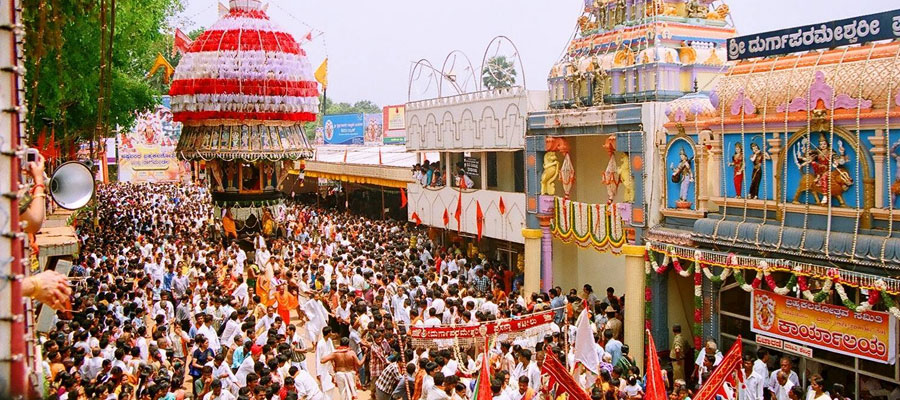
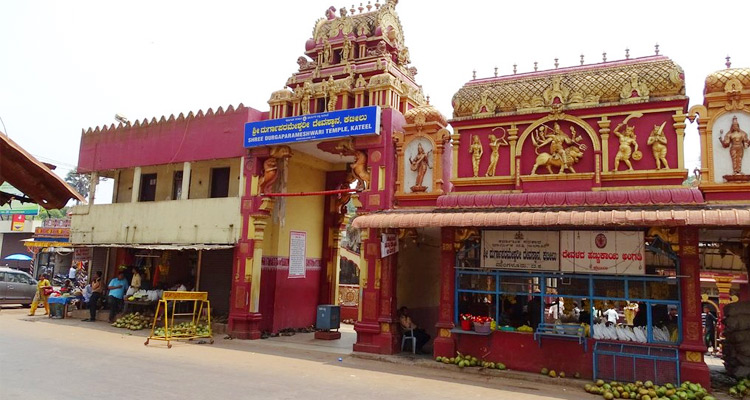
Kateel Sri Durgaparameshwari Temple – History, Sevas, Darshan Timings & Travel Guide
Kateel Sri Durgaparameshwari Temple is one of the most sacred and powerful Shakti temples in Karnataka, located in Kateel, a beautiful village between Udupi and Mangalore. Situated on a small island in the middle of the Nandini River, the temple is admired for its divine energy, scenic surroundings, and centuries-old traditions. Devotees from Karnataka, Kerala, and across India visit Kateel to seek the blessings of Goddess Durga Parameshwari, the Mother Goddess known for protection, prosperity, and shakti.
This detailed guide covers the history, temple legends, sevas, timings, how to reach, and everything a devotee or traveller must know before visiting Kateel Sri Durgaparameshwari Temple.
About Kateel Sri Durgaparameshwari Temple
Kateel (derived from “Kati + Illa”) means “centre of the river”, as the temple is positioned right in the middle of the flowing River Nandini. The calm water surrounding the shrine symbolizes purity, cleansing, and divine protection. The temple is one of the most prominent Shakti Peetha-style shrines in Coastal Karnataka and follows rich traditions of the Parashurama Kshetra.
The temple complex includes:
- Main sanctum of Sri Durgaparameshwari
- Sub-shrines of Mahaganapathi, Kshetras, and Nagas
- Yakshagana Mela troupes associated with the temple
- Bhojanashala offering free prasadam
- Traditional halls for sevas and homas
The atmosphere inside the temple is peaceful, devotional, and filled with chants, bells, and the sound of the flowing river.
Temple Legend (History & Origin Story)
During the early part of Kaliyuga, the good earth was struck by famine and pestilence. It did not rain for years. Even Brahmins were constrained to eat meat and the people were on the verge of becoming cannibals. Jabali, the great sage was distrubed in his ‘tapas’ by these troubles. Through his ‘Jnana Drishti’ he realised the root cause of all this. He found that Arunasura, the ‘rakshasa’ who escaped from death and fled when Goddess Durga slew Shambasura had increased his life span by following the teachings of his Guru. He had made the people stop all the yagas and yajnas as a revenge against the ‘devas’, and this had resulted in drought and scarcity for years.
Nandini, however, was firm in her refusal. Jabali, in his anger, cursed that she be born as a river on earth. Nandini prayed for mercy. Relenting, Jabali advised her to pray to Goddess Durga to redeem her from the curse, Nandini appealed to Goddess Durga who appeared to her and informed her that though Nandini would be bom as a river in fulfilment of the curse she, Durga, would be born as Nandini’s daughter at the centre of the river, and in the process, Nandini would attain purification. On Magha Shudda Poornima, Nandini emerged as a river from Kanakagiri. Jabali performed his yajna. The devas were pleased and the earth was once again green and smiling.
When Arunasura realised that the earth was flourishing once again, his anger knew no bounds. He sat in tapas and acquired a boon from Brahma that he would not suffer death from any two legged or fourlegged creature or any destructive weapon. Brahma also blessed him with the Gayatri Mantra, assuring him that as long as he recited the mantra he would be secured from death. Blessed with these powers, Arunasura defeated the devas and conquered Heaven. In their alarm, the devas implored Goddess Durga for help. Durga suggested that they should somehow prevent him from reciting the mantra and then she would find a way of destroying him. The devas sent Purohit Brahaspathi to Arunasura Brahaspathi praised Arunasura’s powers and questioned the necessity of his reciting a mantra to another god. When he himself had risen to the eninence of a god by his own exploits. Flattered by this praise. Arunasura gave up reciting the protective Mantra.
Moved by compassion, jabali desired to alleviate man’s sufferings and decided to perform a yajna to placate the devas. He approached Devendra in Heaven with a request to permit him to take Kamadhenu for the ritual. Devendra informed jabali that Kamadhenu was not available but he could take her daughter, Nandini in stead. Jabali then went to Nandini who, however refused to accompany him to the sinful earth which had nourished such evil beings as Ravana and Karthivirya. Jabali countered this by saying that the same earth had also produced such saintly beings as Ahalya.
One day Goddess appeared in Arunasura’s garden as a beautiful woman. Seeing this charming apparition, Arunasura inflamed with desire, approached her. The charming beauty reminded him that she was the same woman who had killed Shambasura and from whom Arunasura had escaped death. Conscious of and confident in his newly acquired powers, he rushed forward, sword in hand, to slay her: She disappeared into a stone. Arunasura slashed the stone with a sword, when a vast swarm of bees emerged from the stone and stung him.
The Queen of bees “Ugra Bramari” stung him repeatedly till his last breath. Devas led by Jabali performed abhishekam with tender coconut water and requested the Ugra Bramari to bless the world with her “Soumya Roopa” Goddess Durgaparameshwari then appeared in her “Soumya Roopa” in the middle of the river, where present structure of the temple imparts its glory to the world. ‘Kati’ being the word which means “center” (midway between the “Kanakagiri” the place where the river was born, and the end, parvanje, where the river joins the sea) and “lla” means area. Thus place is called “Kati+ lla” Kateel.
Daily Rituals & Sevas at Kateel Temple
Kateel Sri Durgaparameshwari Temple is famous for its disciplined puja routines and a wide variety of sevas, performed throughout the day.
Major Daily Sevas
- Panchamritha Abhisheka
- Kumkumarchane
- Durga Namaskara
- Mahapooja
- Deepalankara Seva
- Alankara Pooja
Popular Devotee-Sevas
- Anna Santharpane
- Tulabhara
- Sahasranama Kumkumarchane
- Homa & Havans
- Durga Parameshwari Archana
- Navagraha Sevas
- Yakshagana Seva Sponsorship (unique to Kateel)
Devotees can book sevas directly at the temple office.
Kateel Yakshagana Mela – A Cultural Treasure
Kateel Temple is known for its Yakshagana troupes, famously called Kateel Mela.
The temple operates multiple Yakshagana teams that travel across Karnataka performing devotional plays from October to May.
The Mela is considered:
- A symbol of Kateel temple’s cultural heritage
- A spiritual offering to Goddess Durga
- A unique attraction for tourists and art lovers
Kateel Temple Timings
Morning: 4:00 AM – 2:00 PM
Evening: 5:00 PM – 9:00 PM
(Darshan timings may change on festival days.)
Festivals Celebrated at Kateel Temple
Kateel is one of the most festival-rich temples in Karnataka. Major celebrations include:
- Navaratri Mahotsava
- Annual Jatre (Car Festival – Rathosthsava)
- Durga Ashtami
- Deepavali
- Datta Jayanti
- Yakshagana Season Opening Festival
During these festivals, thousands of devotees visit the temple for darshan, sevas, and annadanam.
Free Prasadam & Bhojanashala
The temple is well-known for serving free prasadam meals to all devotees daily.
Meals include: Rice, Sambar, Rasam, Payasa (on special days)
The prasadam is considered blessed, pure, and sattvic.
How to Reach Kateel Sri Durgaparameshwari Temple
Kateel is easily reachable from Udupi, Mangalore, Mulki, Bangalore, Mysore, Mumbai and Kerala.
By Road
- Udupi to Kateel — 45 km
- Mangalore to Kateel — 26 km
- Mulki to Kateel — 12 km
Bangalore
Mysore
Mumbai
Frequent private buses and KSRTC buses connect Kateel from all Mangalore, Udupi and Mulky.
By Train
Nearest railway stations:
- Mangalore Junction
- Mulki Railway Station
By Air
Mangalore International Airport is just 15 km away.
Best Time to Visit
The ideal time to visit Kateel is:
- October to March (pleasant weather)
- During Navaratri or the Kateel Jatre for a grand temple experience
However, the temple remains a peaceful pilgrimage spot throughout the year.
Nearby Places to Visit
You can combine Kateel temple with:
- Kadri Manjunatha Temple
- Kudroli Gokarnanatha Temple
- Polali Rajarajeshwari Temple
- Udupi Sri Krishna Matha
- Kapu Beach
- Sasihitlu Beach
Address and Location Map of Kateel Temple
Google Map Link to Address: https://goo.gl/maps/VQeaBezsphw4Kbcz8
Address: Kateel Post Mangalore – 574148
Phone: +91 74115 34591, +91 89049 05361
Email: kateelkateel@gmail.com
Why UdupiPages Is Your Trusted Source for Temple Information
UdupiPages provides reliable, easy-to-understand temple guides with:
- Verified history and cultural information
- Updated timings & sevas
- Travel guidance
- Local tips for devotees
- Temple listings for better online visibility