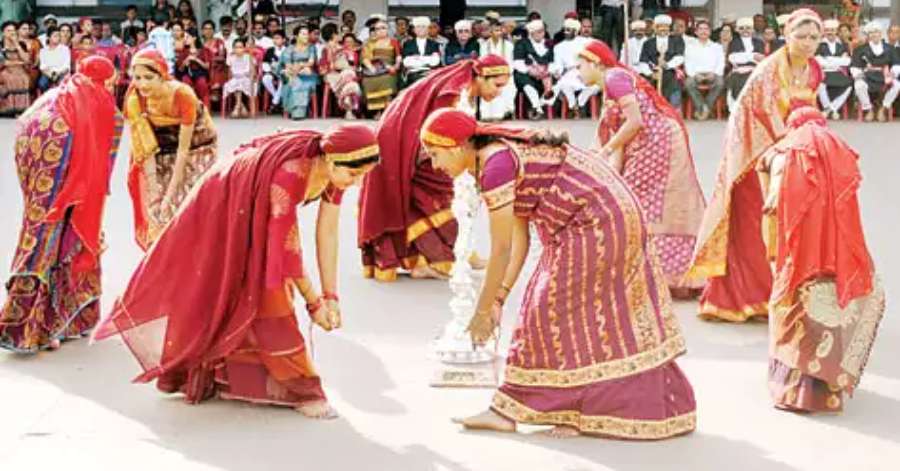
Participants are exclusively women folk of Coorg ethnic. The myth says that on the occasion of ‘samudra manthan’ (churning motif) the distrubution of ‘amruta’ (nector) went in the hands of Vishnu who he appeared in the guise of ‘moohini’ (female roll). The replica of ‘moohini’ and dance is today named as ‘ummattata’ in the Kodava region. Kodava women folk wear the Kodava national dress with jewellary ribben on the forehead and kunkum, holding the bross cymbals in their hands, in a swinging rhythem they dance in the circle. At the centre one women stands with a pot full of water who she represent water diety ‘Kaveri’. Kodava people worship the ‘Kaveri Diety’ as their community goddess.
Ummattat, a vibrant and graceful folk dance, stands as a quintessential expression of the rich cultural heritage of the Kodava community, primarily residing in the Coorg (Kodagu) region of Karnataka, India. This captivating dance form, performed exclusively by women, is not merely a spectacle of movement but a profound ritual deeply intertwined with the spiritual beliefs and social fabric of the Kodavas. It embodies devotion, tradition, and the unique identity of a community known for its distinct customs and martial spirit.
At its core, Ummattat is a devotional dance performed to propitiate Mother Kaveri (Cauvery), the revered prime deity of the Kodavas. The river Kaveri is considered sacred, a life-giver, and the spiritual mother of the community. The dance is believed to be a symbolic representation of Vishnu’s Mohini avatar, who enchanted and mesmerized both gods and demons during the Samudra Manthan (churning of the ocean) to distribute the elixir of immortality. This mythological connection elevates Ummattat beyond mere entertainment, positioning it as a sacred art form that seeks blessings and expresses gratitude.
The performance of Ummattat is a visually enchanting experience. Typically, a group of Kodava women, adorned in their traditional finery, form a large circle. At the center of this circle, one woman stands, holding a pot filled with water, symbolizing Mother Kaveri. The dancers move with a gentle, swinging rhythm, their steps synchronized and fluid, creating a mesmerizing flow. Each dancer holds a pair of small brass cymbals (known as taal or kainchira) in their hands, which they strike in unison, producing a soft, melodious clang that complements their movements and the accompanying songs. The rhythm is generally slow and meditative, gradually building in tempo as the dance progresses, reflecting a journey of devotion and spiritual trance.
The attire worn by the Ummattat dancers is as significant as the dance itself, reflecting the unique sartorial elegance of Kodava women. They don the traditional Kodava saree, draped in a distinctive style with pleats tucked at the back and the pallu (end piece) brought over the right shoulder and secured in front. Often, these sarees are in rich, vibrant colors, with red brocade being a popular choice for performances. Complementing the saree are full-sleeved jackets and traditional Kodava jewelry, including elaborate necklaces, earrings, and bangles. A prominent kumkuma (vermilion) mark adorns their foreheads, signifying auspiciousness and devotion. The head is typically covered with a traditional scarf or veil, adding to the grace and modesty of the dancers.
The musical accompaniment for Ummattat is primarily vocal, with the dancers themselves singing devotional songs, known as paddanas. These songs are often prayers to Mother Kaveri, narratives from the Siri epic, or hymns praising various deities. In some performances, the rhythmic beats of traditional Kodava drums like the dudi (an hourglass-shaped drum) or other percussion instruments might subtly support the vocal renditions, enhancing the overall auditory experience. The emphasis, however, remains on the harmonious singing and the rhythmic clang of the brass cymbals.
Ummattat is performed on various auspicious occasions and festivals throughout the year, particularly during harvest festivals like Huttari (Puttari), which marks the reaping of new paddy crops, and other religious gatherings. It is also a common feature at cultural events, community celebrations, and temple festivals, serving as a powerful symbol of Kodava identity and tradition. While historically performed by married women, increasingly, unmarried young women also participate, ensuring the continuity of this cherished art form.
In recent times, efforts have been made to promote and preserve Ummattat, with cultural academies and dedicated artists like Rani Machaiah, known as the “Ummattat Rani,” playing a pivotal role in teaching the dance to younger generations and showcasing it on national and international platforms. Ummattat, therefore, is more than just a dance; it is a living tradition, a spiritual offering, and a beautiful testament to the enduring cultural legacy of the Kodava people.